Showing posts with label asyr. Show all posts

Friday, February 14, 2014

Spells: Five Updated Spells for Swords & Wizardry

I posted a revised spell list for the gondlir, including a number of updated (or new) spells that don't appear in the official S&W rulebooks. These are the first level spells. In "normal" games, command and vow are 1st-level Cleric spells; know history is a 2nd-level Cleric and Magic-User spell; precipitation is a 1st-level Druid spell; and chant of valor is a 2nd-level Cleric spell (it's really weak, but bless is 2nd-level and this is roughly the same, so...)


Chant of Valor
Level: 1
Range: 60 foot radius around you
Duration: Concentration
You sing, chant, or recite a poem, and by doing so all allies within range receive a +1 bonus to attack rolls and saving throws vs fear for as long as you continue this spell. You cannot cast another spell while chanting, but you can melee. If you take damage, you must make a saving throw to keep chanting.

Command
Level: 1
Range: 30 feet
Duration: 1 round
The target must make a successful saving throw or obey your one-word command for one round. They must be able to understand the command.

Know History
Level: 1
Range: Touch
Duration: Instant
This spell reveals the commonly known or public history of a person, item, or place. It does not reveal disguises, aliases, secrets, or private facts. The caster must touch a person or object, or be in a place to cast this spell.

Precipitation
Level: 1
Range: 30 foot radius burst within 60 feet.
Duration: 1 round per level
A light drizzle begins in the target area, even indoors or underground. This moisture extinguishes small, unprotected fires (such as candles) in the first round, and diminishes medium fires, like torches and campfires, by 50% (and their visibility by the same amount). Larger fires are unaffected. Ranged attacks suffer a 50% reduction in range through or in the area of precipitation.

Vow
Level: 1
Range: Touch
Duration: Permanent
The target swears a vow before the caster to perform a specific deed within an allotted period of time. If the deed is accomplished, the target receives a +5% experience point bonus for all experience points gained in pursuit of the deed. If the target fails, he forfeits 5% of the same experience points. Multiple vows do not stack. If a character vows to defeat the Red Wolf of Izenhold, and recover the Carnelian of Autarch Zarand, and recovers the latter from the body of the former, the xp bonus is +5%, not +10%. If the character kills the Red Wolf, and later in the adventure recovers the Carnelian, the xp bonus is still +5%, since the Carnelian vow remains in force after the Red Wolf vow is completed. A character could have competing or clashing vows.

Monday, February 10, 2014

Looking at Loki (Briefly)

I've been going through my image archive (I think I'm getting enough material to say that without sarcasm), and a recent comment on this blog made me think about how Loki is depicted in art, specifically art from the late 1800's and early 1900's (which is when most of my material is from).

This image, by Arthur Rackham, is how a lot of us think of Loki:


He's positively fiendish. You can see the connection between this and Tom Hiddleston's lean, clean, almost effeminate look. Rackham uses the cultural symbolism of the devil to make Loki's nature clear to the reader. Loki looks evil.


I prefer Elmer Boyd Smith's approach. This is Idunn being carried off by Thiazi, Skadi's father. Loki lures her outside of Asgard so Thiazi can capture her.

And this. At Loki's suggestion, Thor is being dressed up as a bride to trick the giants.  Loki is peering out from behind the curtain (there's probably intimations of Loki being a peeping tom/pervert in this, as he's looking into the women's realm, not to mention the more literal interpretation of witnessing Thor's cross-dressing, which Thor would clearly rather remain secretive about.The goddess on the right is Frigga; Freyja is on the left, with the cats. )


Loki is kinda hefty, with a beard and a receding hairline.  He looks like a Viking, not an elf-sprite. He looks like Shakespeare. It's a hard left turn from Rackham's diabolical depiction. Not the sort of person you expect to bring about Ragnarok and the destruction of the gods, but that's what makes it interesting. No one is surprised that Rackham's Loki is the father of Hel, Fenris, and the Midgard Serpent, but this guy?  This guy is the villain?

Therein lies a tale.


Friday, February 7, 2014

Notes on the Norse Classes: Overview, creative urges, and so forth.

Just over a year ago, John Stater posted an article on his Land of Nod blog translating several members of the Norse pantheon into individual races: the freyling, lokai, thunor, and wotani. It was an exercise in using the pantheons as the basis for demi-human races, and I thought it worked quite well.

But.

Everyone's creativity is different. Some people excel at creation ex nihilo: from nothing. I do not. I springboard off of existing ideas, turning them around, rearranging parts, looking for gaps, disassembling them to find the logic, building them up again, and then springboarding off of that.

I can honestly say I would never have thought of turning the deities into races, but the instant I saw the article, I had to turn it around and ask: What if you turned the gods into classes? What would a 4th-level thor be like? A 1st-level odin? A 9th-level loki?

Other projects took my attention for awhile, but the concept was stuck in my head. I did some occasional research, made some decisions, and finally decided to go for it. The results will be posted over the next few weeks. I hope you enjoy them.

Guiding Principles
The classes must read as something new, not just an old class with a new name.
The classes must be compatible with existing classes and rules.
The classes are translations of the gods themselves, not devotees or servants of the gods. (These are not "just" skalds or valkyries or berserkers.)
Draw inspiration from, not slavish devotion to, the mythos. Be flexible.
Ideally one could create a party composed of nothing but the norse classes, and have it be an effective mixture of abilities.

The classes and their concepts can be separated into several groups:

The Big Three.
These were obvious.
  • Gondlir ("Wand-bearers") - The Odin-class. Preeminent in magical lore, capable warriors, but morally grey.
  • Rymr ("Noise") - The Thor-class.  Warrior-Champions.
  • Slaegi ("Sly") - The Loki-class. Trickster-magicians with elemental affinities.
Well-Known Gods
These were trickier. People are very familiar with the Norse mythos, but there's a fair amount of overlap in the capabilities and roles of the gods. It's extremely likely that many of the personalities we identify today were merged in some manner in the past - Tyr's name, for instance, literally means "god". Frey means "lord". Freyja's ("Lady") husband Odr is virtually unknown in the sagas, except that he disappeared for a time and Freyja went in search of him, having adventures of his own. It's speculated that Odr may be a variation of Odin, which would make Freyja a version of Frigga. I chose which gods to translate based on the clarity of their concept and how well it applied to an adventuring party.
  • Skade (unclear) - Skadi. Ranger/Scout. Skadi isn't particularly well known anymore, but she's one of the most unique Norse goddesses and has some pretty rockin' adventures. She doesn't take shit.
  • Vallir ("Bearer of the Slain") - Freyja. Witch-warriors. Stronger emphasis on protective and healing magics than the gondlir.
  • Vindler ("One Protecting Against The Wind") - Heimdallr. Martial guardian/protectors.
Niche Concepts
I might write some or all of these up, but they're more niche concepts, less suited to adventure, or fall outside of the immediate project scope.
  • Helreggin ("Ruler of Hel") - The Hel-class. Not a niche, actually. Necromancer-priest type. In the mythology, Odin & Freyja split the valiant dead, and Hel gets the rest.
  • Idunn - The guardian goddess of the apples of youth. One of the few goddesses that is notably not Freyja/Frigga. I've had a few thoughts about translating her into a class.
  • Tyr - A god of justice and kingship screams "paladin", and I haven't worked out how to do this without a) paladin, and b) having too many fighter-types.
  • Frey - A god of fertility and nobility screams "druidic paladin". See Tyr, above.
  • Frigga - Mostly appears as a wife and mother. Strong leadership material, but difficult to make work in an adventuring setting without turning her into a generic healer.
  • Uller - A lot of overlap with Skadi, unfortunately. He's the proto-typical ranger.
  • Baldr - Pretty boy. And he dies. Frey is a pretty boy too, and he ain't dead.
  • Dvergr - Dwarfs. Not a god, but makes sense. A quasi-magical thief/fighter class.
  • Alfar - Elves. Less defined in the mythos than the dvergr, aside from associations with light. Would be considerably toned down from the fighter/magic-users of D&D, but otherwise conceptually unclear right now.
A Note On Language
I do not speak any Scandinavian languages. I didn't even talk to someone who did while I was writing this. Rather than using the names of the gods as the names of the classes (it seemed weird, have a 3rd-level odin and a 4th-level loki), I pulled from lists of variant names each god was known by. This is a little tricky with the goddesses, as many of the variations end with "dis", which means "Lady", and I wanted to avoid really overt gender references*. I'm not sure if -lir/ler is masculine or neuter; most translations treat it as neuter, so I've used Vallir in place of Valdis for the Freyja-class.

*The -ess ending in English stems from the Latin -issa, but the scandinavian "god-dis" and "godd-ess" both translate as "female deity". Indo-European roots, I'll bet.

Revised Spell List for the Gondlir

Here's the revised spell list for the gondlir. It incorporates a bunch of new (old) spells that haven't been available in S&W (I've had a busy few hours), and takes out a couple that I didn't find interesting. Emphasis on thematic spells for the gondlir, and fleshing out levels that didn't have enough spells.
I will probably post the actual spells later. Asterisked* spells are the new/not-in-the-S&W-Complete-Rulebook spells.


Thursday, February 6, 2014

The Gondlir Class

Gondlir ("Wand-bearer")

http://www.elfwood.com/~danmills/Odin-Sketch.2663780.html
The gondlir are a class of spellcasting warriors, and it is from their ranks that leaders of the Asyr are most often drawn. They are knowledge-keepers, decision-makers, sages, poets, and fighters. Their charge is to do what is best for the Asyr, by any means necessary.  Rymr or vindlir might lead in brawl or battle, but gondlir choose the war.

The nature of their role in society makes gondlir schemers, planners, and far-thinkers. A gondlir might go undercover as a wanderer to find out what is happening in other lands, or trick someone else into spying for him. They are not shy to directly intervene when trouble arises, but it is more typical that a gondlir will find a reason to send a rymr on a simple errand, one that just happens cross paths with the problem the gondlir wants solved.

Initiation to the ranks of the gondlir comes only after a long period of study and memorization in the accumulated knowledge of the Asyr and as a result, gondlir have an extensive store of wisdom and learning to call upon in the form of poems, stories, and tales. The heart and soul of a gondlir’s might are his secrets, mysteries, and lore - the spells of the gondlir. Even the best-intentioned gondlir knows things that cannot be spoken of, and the weight of their responsibilities makes them secretive and isolated, even among friends and companions. 

Gondlir are regarded as the most proficient magicians of the Asyr, although the slaegi dispute this. Gondlir magic focuses on divination, inspiration, deception, and manipulation, and they have some influence of the natural world and weather as well.


In fiction, JRR Tolkien's Gandalf is an excellent depiction of a gondlir. Manipulative spellcaster with a sword; dies and comes back stronger and better.

Prime Requisite: Intelligence, 13+ (+5% experience bonus)
Hit Dice: 1d6 per level (+2 hp per level after 9th level.)
Armor Permitted: Light or medium armor, shields
Weapons Permitted: Any one-handed weapon, plus bows, spears, and staffs.
Alignment: Gondlir are always Neutral.


Class Features
Gondlir Lore: Gondlir have a 1 in 6 chance of knowing something about a notable person, place, item, or creature. This improves to 2 in 6 at 3rd level, 3 in 6 at 6th level, 4 in 6 at 9th level, and 5 in 6 at 12th.


Spells: Gondlir cast spells from a personal list of spells they have learned. Each morning they prepare a number of spells equal to the Spells per Day entry for their level, chosen from the spells that they know. (A spell may be prepared multiple times if the appropriate “slots” are available.) Once cast, a spell is exhausted and must be prepared again (the next morning).

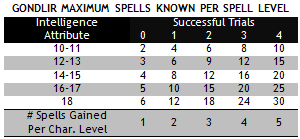
Gondlirs begin play knowing two spells, and automatically learn one additional spell each time they gain a level. Gondlir can also learn new spells through a process of experimentation and observation that takes at least 1d6 days per spell level, after which they make a percentile roll on the Chance to Understand New Spell column in the Intelligence table. Failure means the gondlir cannot learn that spell this level; success means the gondlir adds the spell to his list of spells known. A gondlir can only know a certain number of spells per spell level, however, as given on the chart below (note that this number is different from, and used instead of, the Min/Max Number of Spells Understandable per Spell Level on the Intelligence table.)


Trial of Shadows: Of all the Asyr, only the gondlir can enter Hel and return unaided. Anytime the gondlir is reduced to -1 hit points or less, he can attempt a Trial by rolling a saving throw. If the save is successful, the gondlir is restored to life with 0 hitpoints, and heals naturally thereafter (awakening in 1 day with 1 hit point). If the save fails, the gondlir dies. (If variant rules are used that normally cause death to occur at lower than -1 hit points, the gondlir automatically loses drops below that number with a failed save.) The gondlir may be restored to life as normal afterwards, but is still considered to have failed the Trial . If the gondlir died as a result of ongoing damage, that damage ends if the cause is internal (poison) and continues if the cause is external (engulfed in magma). A gondlir that dies as a result of disease continues to be afflicted (and may die again).

A Trial may be spontaneous (the result of battle) or planned (ritual sacrifice). The fates appreciate cleverness and forethought, so a prepared gondlir may undertake measures to increase his chances of successfully making the saving throw, but neither are the fates blind: the same methods cannot be used twice (this is not an automatic failure; the methods simply do not affect the save).

The greatest secret of the gondlir, however, is what they learn along the shadowy paths back from Hel. A gondlir that succeeds at a Trial returns to life increases their maximum number of spells known and the number of spells learned at each level increase. This happens only once per level, even if the gondlir undertakes (and succeeds at) multiple Trials.