Tuesday, January 22, 2013

The Ranger Class


Ranger
Goblin-hunter, giant-killer, dragon-slayer: these are rangers.  They are independent, cunning, and experienced in fighting the monstrous creatures that prey on civilization.  They live in the frontiers and borderlands, protecting gentler lands by hunting threats in the wilderness.

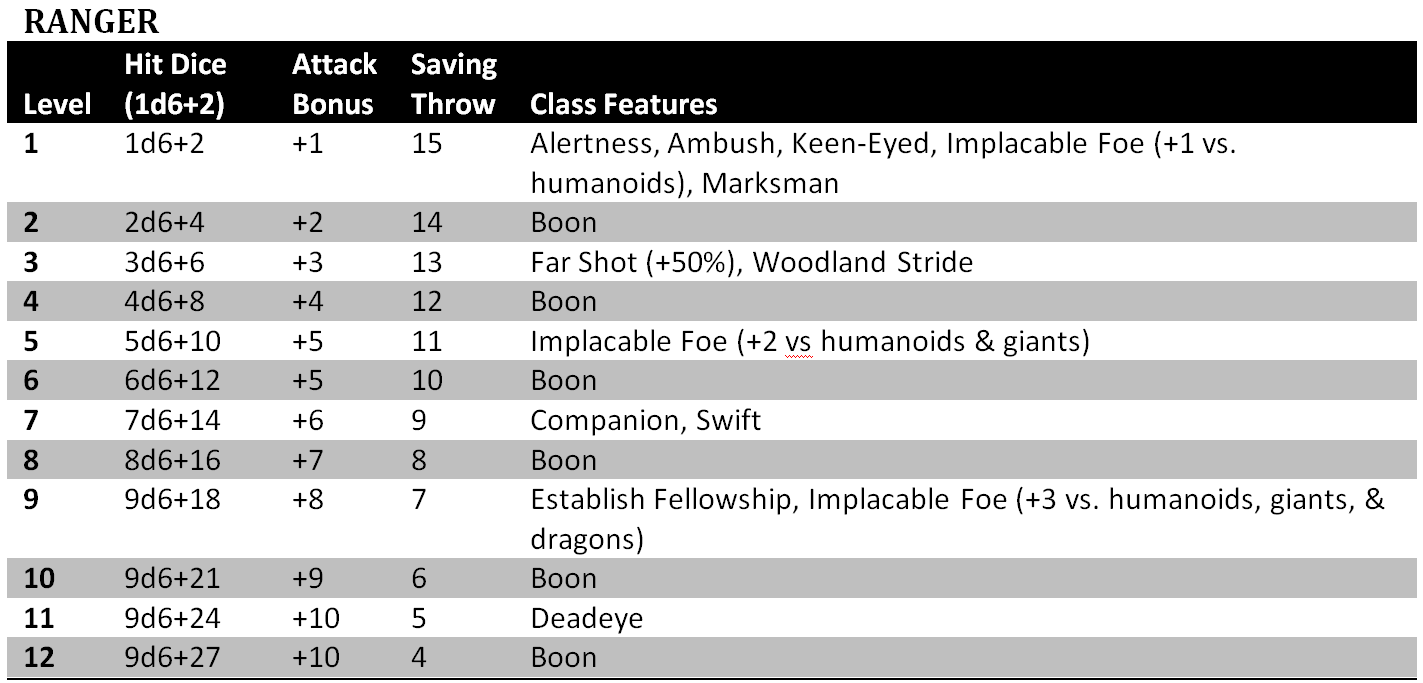
Hit Dice: 1d6+2 (+3 hp per level after 9th level.)
Armor: Any light or medium armor, shields.
Weapons: Any weapon.
Skills: Feats of endurance and dexterity, climbing, natural lore, perception, stealth, swimming, survival, and tracking.


Restrictions
Self-Sufficient: Rangers, by temperament and training, do not rely on others.  They do not adventure with more than two other rangers, and do not keep more wealth than they can easily carry.  Fellowships often include more than three rangers, but they spread their protection out over a large area, and do not travel together.

Class Features
Alertness: Rangers have only a 1 in 6 chance of being surprised.

Ambush: A ranger can create an ambush, increasing the chance of surprising an opponent.  This takes one round per party member, and adds 1 to the chance of surprising the opponent.  Characters that are have knacks or skills in hiding or sneaking do not add to the preparation time.  The ambush is stationary and the targets must move into it.

Opponents that are expecting a fight, and would not ordinarily be surprised, instead have a 1 in 6 chance of being surprised, at the GM’s discretion. 

Keen-Eyed: Rangers have advantage on perception and tracking checks.

Implacable Foe: A ranger has a +1 on rolls against the humanoid races (bugbears, gnolls, goblins, hobgoblins, kobolds, ogres, and orcs) at 1st level. This applies to saves, checks (i.e. tracking or surprise), attack rolls, and damage rolls. This increases to +2 at 5th level, and includes giants and trolls.  At 9th level the bonus becomes +3, and includes dragons.

Whether or not the bonus applies is at the GM’s discretion.  It is reasonable to apply it to a save versus a goblin trap in a goblin lair, but not against a trap in a thieves’ guild that includes goblins as members.

Marksman: A ranger adds his Dexterity bonus to his to-hit roll with ranged weapons.

Far Shot: At 3rd level, the range on a ranger’s missile weapons increases by 50%.

Woodland Stride: At 3rd level, the ranger moves at his normal movement rate through non-magical wilderness, including undergrowth and other hindrances, and cannot be tracked except by a ranger of higher level.

Companion: At 7th level the ranger gains a companion.  This might be a 1st level ranger, or an animal companion. If the companion dies, another will replace him the next time the ranger gains a level, depending on the circumstances surrounding the death of the previous companion(s). 

Swift: At 7th level the ranger’s speed increases by either +10 feet per round or +3, depending on the rule system.

Fellowship: At 9th level the ranger attracts a small band of like-minded allies and companions to aid and assist him.  Intelligent animals, monsters, and various player-character races are all possible members of the fellowship.

Deadeye: Once per day at 11th level the ranger can make a careful, steady attack on a foe.  For each full round he spends aiming, the ranger gets a +2 bonus to hit, to a maximum of +6 at three rounds.  In addition, he does double damage after the first round of aiming, triple damage after the second round, and quadruple damage after the third round.
The ranger cannot move while aiming, and the target must be visible, within range, and not moving faster than a walk.  Any damage to the ranger while he is aiming disrupts his attack. 

(The terms advantage, knack, and skilled are defined on the Game Design page above.  The license for this entry is located in the Legal page above.)

Update Monday: Tweaks, Primes, and Crack the Whip.

Tweaks & Updates
I tweaked the barbarian class a little.  Added an extra hit die at first level, Superstitious as a restriction, and Resolute as a new feature (bonus to poison, paralyzation, and other effects that restrict the barbarian's movement).  The extra die gives the barbarian that little bump in hit points.  You can lose the Superstitious restriction, but you lose the extra points as well.

I tweaked the ranger as well, but since that hasn't posted yet, you won't be able to tell.  ;)


Replaced the makeshift chart in the Leshii (race-as-class) entry with one that matches the recent classes.  No change to content.

In a more general change, I've abandoned the whole prime attribute scheme.  It wasn't working how I wanted.  I've got a new idea that doesn't impact the classes, so I'll write it up later on.


I'm way behind where I hoped to be.  I've got other things I need to work on, so I'm going to have to crack down, get organized, and work faster.

Monday, January 21, 2013

The Fighter Class


Fighter
Hit Dice: 1d6+2 (+3 hp per level after 9th level.)
Armor: Any armor, shields.
Weapons: Any weapons.
Skills: Fighters are skilled at feats of strength and endurance.  A fighter may select up to three additional skill areas.


Class Features
Applied Force: A fighter adds her full Strength bonus to her attack rolls as well as to her damage rolls.

Dominate: Against creatures with one hit die or less, a fighter makes one attack per level each round.

Weapon Mastery: At first level, the fighter selects one class of weapons: axe, bows, club, crossbows, dagger, darts, flail, mace, pole arm, sling, spear, sword, and two-handed sword.   She receives a +1 bonus to hit and damage with these weapons.  This increases to +1/+2 at 3rd level; +2/+2  damage at 5th level; +2/+3 at 7th level; and +3/+3 at 9th level.
Alternatively, the fighter can select a new weapon group at 5th level (and/or 9th level), gaining a +1/+1 with the new group, which increases to +1/+2 at 7th level.  Either group, or a new group, may be advanced at 9th level.

Parry: At 3rd level, the fighter gains the ability to parry, adding her base to-hit bonus to her armor class.  She cannot attack on any round that she parries.

Shield-bearer: At 7th level, a fighter gains a 1st-level fighter henchman.  If the squire dies, another will replace him the next time the fighter gains a level, depending on the circumstances surrounding the death of the previous squire(s).  Frequent or suspicious deaths are likely to incur repercussions, particularly if the shield-bearer is from a powerful household.

Stronghold: At 9th level the fighter may establish (or have conferred upon her) a stronghold and with it a body of loyal men-at-arms who will swear fealty to her. 

Flurry of Steel: At 11th level, the fighter gains a second attack per round.  If she chooses to parry instead, she gain an additional +2 bonus to her parry bonus.


(The terms advantage, knack, and skilled are defined on the Game Design page above.  The license for this entry is located in the Legal page above.)

Sunday, January 20, 2013

The Mabinogion: Cei ap Cynyr


Cei, Son of Cynyr

“Thereupon Cei rose up. Cei had this peculiarity, that his breath lasted nine nights and nine days under water, and he could exist nine nights and nine days without sleep. A wound from Cei's sword no physician could heal. Very subtle was Cei. When it pleased him he could render himself as tall as the highest tree in the forest. And he had another peculiarity,--so great was the heat of his nature, that, when it rained hardest, whatever he carried remained dry for a handbreadth above and a handbreadth below his hand; and when his companions were coldest, it was to them as fuel with which to light their fire.” – Culhwch & Olwen, The Mabinogion

Cei ap Cynyr; human male barbarian 12

AC: 20; HD: 9 (hp 70)
Atks sword of wounding +2; +12 to-hit, 1d8+8 damage  OR rage: sword of wounding +2; +16 to-hit, 1d8+12 damage)
Save 3; Speed: 40 (15)
S:18, C:18, D: 15, I:14; W:9, Ch:14
Boons: Fast Movement, Magical Aptitude (enlarge), Magical Aptitude (endure elements), Power Attack, Toughness (x2)
Equipment: Bag of holding, chainmail +3, gauntlets of ogre power, shield +1, sword of wounding +2

Cei is Arthur’s most loyal and fearsome champion, and one of the best warriors in the land.  He is renowned for his supernatural fortitude and resilience, and feared for his incandescent fury.  Years and blood have taught him cunning and a wide array of dirty tricks, all of which lead to the same place – beneath the sharp edge of his sword. 

Cei’s greatest weakness is his pride.  His willingness to trick opponents is sometimes a source of humor from other members of Arthur’s court, which does not please him.  Cei finally breaks from Arthur because of a short poem Arthur composes poking fun at Cei.  Cei is later slain by Gwyddawg, who is in turn slain by Arthur in retribution for Cei’s death.

Sir Kay breaketh his sword at ye tournament, by Howard Pyle

The Barbarian Class


Barbarian
Hit Dice: 1d6+2 (+3 hp per level after 9th level.)
Armor: Light or Medium armor, shields.
Weapons: Any except crossbows.
Skills: Barbarians are skilled at feats of strength and endurance.  They are also skilled at survival, climbing, and swimming.


Restrictions
Superstitious: Barbarians mistrust overt displays of magic and sorcery.  When presented with displays of such magic they must succeed at a saving throw or be stunned for one round.  A barbarian character may overcome this restriction, but permanently loses 1d6 hit points.

Class Features
Dominate: Against creatures with one hit die or less, a barbarian makes one attack per level each round.

Powerful: Barbarians have advantage in feats of strength and endurance.

Rage: The barbarian can go berserk in combat, gaining a +2 bonus to hit and damage, but suffering a -2 penalty to his armor class.  This increases to +3/+3 at 5th level and +4/+4 at 9th level. For purposes of language and communication, the barbarian’s Intelligence score drops to 3. The barbarian’s rage lasts for a number of rounds equal to the barbarian’s level.  While in his rage, the barbarian focuses on his foes until they are dead.  He cannot use skills except for feats of strength, and no skills that take longer than a round. If his rage continues after his foes are gone, he will attack his nearest ally unless he makes a successful saving throw.

The barbarian’s rage can be reawakened or extended beyond its normal duration by making a successful saving throw each round.  Each successful save extends the rage by one round, incurs a cumulative -1 penalty on subsequent saves to continue, and lowers the barbarian’s Strength score by one point after the rage ends.  The Strength penalty disappears after 8 hours of rest.

Animal Reflexes: At 3rd level, the barbarian gains advantage against surprise attacks and traps.

Cleave: When the barbarian drops an opponent to 0 or fewer hit points, he may make a second attack with the same weapon against a new foe that is within reach.

Tenacity:  At 7th level the barbarian can continue to fight after losing all his hit points, so long as he is raging.  The barbarian ends when the rage does.

Youngblood: At 7th level, a barbarian gains a 1st-level barbarian henchman.  If the youngblood dies, another will replace him the next time the barbarian gains a level, depending on the circumstances surrounding the death of the previous youngblood(s).  Barbarians are not particularly put off by frequent deaths, but the death of a youngblood by sorcery or other foul means are viewed with distrust and may incur repercussions.

War band: At 9th level the barbarian becomes a leader among his people, whether he likes it or not, and can summon a war band to accomplish a particular task or objective.  The exact number and makeup of the war band will depend on the goal to be accomplished.

Whirlwind: At 11th level, while raging, the barbarian can make an attack at every creature he can reach without moving at his normal attack bonuses, but suffers a -4 penalty to armor class (instead of -2) while doing so.  The barbarian cannot chose to hit some creatures and not others. 


Steppe Nomad (Barbarian Variant)
Steppe nomads are members of migratory horse-riding cultures.  They are renowned for their skill in fighting from horseback.  Their traditional weapons are powerful short bows and curved sabres.

Skills: Steppe nomads have riding instead of swimming.
Saddleborn: Steppe nomads have advantage in riding instead of feats of strength.
Mounted Warrior: Steppe nomads lose the Rage class ability and gain the Mounted Warrior ability in its place.  The bonuses remain the same, but apply only when the steppe nomad is mounted.  There is no duration to this feature, and no penalty to Armor Class.
Cleave: This ability only functions when the character is mounted.
Whirlwind: This ability only functions when the character is mounted.  There is no penalty to Armor Class.

Zealot (Barbarian Variant)
Zealots are fanatical religious warriors.  They occupy the same place in cult hierarchies that paladins do in divine orders.

Skills: Zealots are skilled at religious lore and local lore instead of climbing and swimming.
Fervor: This ability is the same as rage.
Divine Aid: This ability replaces Animal Reflexes.  Once per day the zealot can cast cure light wounds upon himself.

(The terms advantage, knack, and skilled are defined on the Game Design page above.  The license for this entry is located in the Legal page above.)

Wednesday, January 16, 2013

On Classes: Martial classes

I'm a "iconic concept" sort of guy when it comes to class design.  Every class should express a core, iconic concept clearly and as simply as possible, and without infringing on other classes except by design.

At the moment, I've come up with four martial/warrior classes, with the potential for at least three more.  They all share the same save progression, to-hit chart, and hit points (yes, even the barbarian), but they do different things.

The fighter is the most generic.  She gets a weapon mastery bonus that slowly progresses as the character levels up; this bonus can be applied to one, two, or three weapon groups.  Concentrating on one weapon gives the highest bonus.  She also has strong defensive ability that can be used in place of an attack, and finally gains a second attack per round.  Fighters can also apply their Strength bonus to their to-hit chance, currently the only class that can do so.

Barbarians don't gain weapon mastery, but they do rage.  This gives a bonus equal or better than the fighter's, but has a limited duration and some potentially serious penalties as well.  Barbarians are also the best at slaughtering massed hordes of weaker creatures, with cleave and whirlwind of steel abilities.

Rangers are the implacable foe, and gain a bonus versus certain types of opponents.  The bonus and number of opponents increases at 5th and 9th level, both to reflect the ranger's increasing expertise and the likelihood of encountering certain creature types.  This bonus applies not only to attacks and damage, but saves and checks as well.  The creature types can easily be changed in different campaigns: evil or outlaw humans, monstrous humanoids, monstrous creatures, spellcasters, etc.

Paladins are the divine opponents of supernatural evil, and hew reasonably close to what's been done before.

Knights, soldiers, and swashbucklers aren't fully defined at the moment, but the concepts are visible.  If barbarians are the masters of brute combat, knights are the elite one-on-fighters of the battlefields, duking it out with the big bad boss monster.  Soldiers are tough, adaptable survivors - sturdy and reliable.  Swashbucklers emphasize dexterity and movement over force and stamina - the chief problem with this class is that it could be very similar to the fighter in execution.

Tuesday, January 15, 2013

The Illusionist Class


Illusionist
Prime Requisite: Intelligence.  An illusionist uses her full Intelligence score to determine languages known and adds her full Intelligence modifier to the number of skills known.

Hit Dice: 1d6 (+1 hp per level after 9th level.)

Armor: None

Weapons: Dagger, Dart, Staff

Skills: An illusionist is skilled in feats of intelligence and perception; magical lore; legerdemain; and lying, smooth-talking, tale-telling, or yarn-spinning.


Class Features

Persistent Illusion: Any illusion the illusionist casts with a duration of “concentration” persists for a number of rounds equal to her level after she stops concentrating. 

Pierce the Veil: Illusionists have advantage on saves against illusions.

Face in the Crowd: At 3rd level the illusionist can cause herself to appear so normal, mundane, and unexceptional that she blends into her surroundings.  All creatures in the area treat her as if she belonged there, effectively ignoring her.  Creatures that directly interact with the illusionist make a save to disbelieve the illusion, and mindless creatures are not affected by it.  The illusionist can do this for one minute per level per day, in increments of one minute.
The illusion does not turn her invisible or allow her to disguise herself as a specific individual or type of person.  She retains her general shape and appearance.

At 7th level the illusionist can extend this ability to include any companions within 30’ of her.

Sense Deception: By 5th level, an illusionist has developed a keen sense of what is real and true, and what is not.  She gains a knack for sensing illusions, lies, and trickery.  This knack does not necessarily indicate what is an illusion or what is a lie, merely the presence of one.  It does not replace a saving throw.

Mirror: At 9th level, the illusionist can appear exactly as another individual of roughly the same body type, and no more than twice as tall or half as high.  The illusionist looks, feels, smells, and sounds just like the target creature.  The effect requires the illusionist to have a portion of the target creature (a hair, drop of blood, a tooth) or significant item ( a scepter or crown, an amulet, a personal weapon).  This item is incorporated into the illusion in its true form, and the effect ends if it is separated from the illusionist.

This effect does not confer any special knowledge or abilities on the illusionist, but the duplication is otherwise seamless.  Creatures that interact with the illusionist do not gain a save to disbelieve.  The illusionist’s actions, or lack of specific knowledge, can cast doubt on her identity, but her true identity cannot be discerned without magical aid.

Mirror lasts for one hour.  The illusionist can extend the duration beyond an hour by making a saving throw, with success indicating the effect lasts for another hour, and failure ending the effect. 

Permanent Illusion: At 11th level the illusionist can cause one illusion to become permanent.  The caster can attempt to make as many permanent illusions as she wants, but doing so requires a saving throw for each additional permanent illusion.  A failed save means all the illusions end.

(The terms advantage, knack, and skilled are defined on the Game Design page above.  The license for this entry is located in the Legal page above.)

Update Monday: Changes to the Game

A quick summary of obvious changes from the base S&W ruleset:

Abilities:  I've toyed with changing Wisdom to "Spirit" and Charisma to "Presence", but have not done so here. 

  • Strength gives a bonus to damage.  Only fighters (and maybe soldiers) get a to-hit bonus right now.
  • Constitution gives a bonus to hit points.
  • Dexterity gives a bonus to armor class.
  • Intelligence gives bonus skills and languages.
  • Wisdom gives a bonus to saves vs magic.  I think.
  • Charisma gives a bonus to reaction checks and the number of henchmen and/or hirelings a character can have.

Ability Scores bonuses: 9-12 +0, 13-15 +1, 16-17 +2, 18 +3

Rolling Ability Scores: I'm going to try a hybrid approach.  Players will have a set of bonuses (+3 or +4) to distribute, and then will roll to determine their exact score within that range.  For instance, a player with a +0 modifier in Strength will roll a d6.  A roll of 1 means a score of 9, 2-3 means a score of 10, 4-5 means a score of 11, and 6 means a score of 12. 

Experience: I don't do it.  I do my best to balance the classes, and leave it at that.  There are so many experience schemes out there, use whatever one appeals to you.

Prime Requisite: So without XP, what does PR do?  Every character will have two Prime Requisites, one from class and one from race.  Characters get full modifier effects of their PRs, and a +1 in anything that qualifies for a bonus but isn't a Prime Requisite.  Yes, right now this means that PR only affects scores of 16 or higher.  I'm still working this out.

Example: Abilard the Dwarf (PR: Con) Thief (PR: Dex) has a 16 Con, 16 Dex, and 16 Strength.  (just go with it).  He gets a +2 bonus to hit points, a +2 bonus to AC, but only a +1 bonus to weapon damage.

Levels: I stop at 12th level.  Some high-level spells will be moved down.  If I do a 12+ level game, it'll move into divine territory and I'll figure it out then.

Advantage: Means a +2 bonus.

Knack: Succeeds on a roll of 16 or higher.

Skilled: Succeeds on a saving throw.

Skills: I'm winging them, more or less.

Feats of...: Catch-all category for bending bars, lifting gates, sundering doors, forced marches,starvation,   puzzles, and stuff like that.

Boons: Feats.

Recharging:  Some abilities will have a "recharge" feature.  This usually isn't a full recovery, it means the effect can be pushed for another round by making a save.  And another round after that with another save.  Exact details will depend on the ability.

Monday, January 7, 2013

Leshii (S&W Race-As-Class)

Note: The leshii classes (male & female) should be used in concert with, and not instead of, the racial abilities in the previous post.


CLASS FEATURES (Male Leshii)

Prime Requisite: Constitution, 13+ (5% experience.) Leshii men rely on durability and stamina to outlast their opponents
Hit Dice: 1d6+2 (+3 hp per level after 9th level.) Leshii men are hunters and brawlers, honed and hardened by their spartan lifestyle.
Armor: Light or medium armor and shields
Weapons: Any.
Class Skills: All leshii are skilled at moving silently and hiding in natural environments. Leshii men are skilled at breaking doors and feats of endurance.
Class Advantages: Their rugged nature gives leshii men advantage (a +2 bonus) on saving throws against poison and disease.

CLASS FEATURES (Female Leshii)

Prime Requisite: Charisma, 13+. Leshii women are naturally charming and skilled at reading others.
Hit Dice: 1d6 (+1 hp per level after 9th level.) Leshii women are adept spellcasters, not fighters.
Armor: Leshii women can wear light armor, but are not skilled with shields or heavier armor.
Weapons: Leshii women can use clubs, daggers, darts, and slings.
Class Skills: All leshii are skilled at moving silently and hiding in natural environments.
Class Advantages: Leshii women can cast spells as a magic-user, and are particularly skilled at enchantment and charms, gaining advantage (either a +2 bonus to a caster’s check, or a -2 penalty on a target’s saving throw) when casting these kinds of spells.


(The terms advantage, knack, and skilled are defined on the Game Design page above.  The license for this entry is located in the Legal page above.)

Leshii (S&W Player Race)


Leshii (Forest Hunters)

The leshii are a race of humanoid nature spirits seemingly hewn from wood.  Male leshii are six to seven feet tall, with nut-brown skin looped and whorled like the rings of a tree.  They are lean and muscular, with rough, craggy features and a crown of branch-like horns.  Leshii women are smaller, and their skin is pale and smooth, reminiscent of birch bark.  They have long gold or ebony tresses and delicate features.

In the Shadowend Setting, leshii are more common in the northern woodlands, notably the Gonenfall, Driathorn, Jarnwold, and the northern reaches of the Shadowend Forest.  They inhabit the deepest forests and woodlands, and are both predator and protector to the other creatures that live there.

Leshii society is attenuated at best; they live solitary, nomadic lives and avoid other leshii when possible.  Their lairs often center on a human or humanoid settlement, or follow the route of a nomadic tribe, who honor and propitiate their guardian spirit. Nature spirits like the leshii are similar to but distinct from fey, who are ultimately other-worldly creatures. The most powerful male leshii in a forest takes the title Druhtinaz, or warlord-king, but this is a title with little real power.

 Leshii are, first and foremost, primal spirits of the forest and the hunt.  Of the nonhuman races, they are the least human in manner, being guided solely by deep instinctual urges and their own whims.  They only faintly understand the concepts of empathy, laws, and civilized society in general.  Leshii are curious and inquisitive, but well-tempered with a predator’s caution and cunning.  They are patient and prefer contests of skill and wit to games of chance, and are adept at feigning weakness or passivity to lure an opponent in.  They are territorial and protective of anything they consider theirs, including adventuring companions.

Adventuring leshii are rare but not unknown.  Young leshii go abroad to find new forests or gain experience, while older leshii become bored, or simply never settle down.  They seek out companions to protect and watch over, and live itinerant, mercenary lives for as long as it amuses them.

Leshii do not use names among themselves, but adopt names given to them by other beings.  As such, their names vary.

RACIAL ABILITIES

Leshii have the following racial abilities:
Knacks: All leshii have a knack for tracking and forest survival.
Nightvision: They can see at night without penalty, but not underground.
Defenses: The tough, bark-like skin of leshii men gives them a +1 bonus to their Armor Class.
Advantages: Leshii women have advantage (a +2 bonus) whenever they need to make a check to influence another person; they can also create a fascination effect similar to a charm person spell.  The leshii must be visible and focused on the target, and the compulsion only lasts a minute.  They cannot fascinate the same person twice in a day, and any obvious threat to the target breaks the fascination.

(The terms advantage, knack, and skilled are defined on the Game Design page above.  The license for this entry is located in the Legal page above.)